2025 Year in Review: Building Better Together
Written by

Chris Garafola
Published on
.svg)
January 2, 2026
.avif)
Table of contents
1. A Year of Building Better with Our Customers
The future of infrastructure isn’t siloed; it’s Better Together.
In 2025, we saw this belief turned into action across the entire infrastructure ecosystem.
From the top ENR design firms to state DOTs, municipalities, and regional engineering teams, our customers didn’t just deliver projects; they drove a fundamental shift in how the built world is planned and delivered.
Their work spanned every corner of the industry, water and waste, transmission and distribution, transportation, land development, telecom, and fiber. Yet across these diverse sectors, each project reinforced the same truth: shared, reliable utility data is the essential baseline for reducing risks, protecting budgets, and driving better outcomes.
In an environment hindered by risk and fragmented data, our customers used 4M to dismantle silos and bring clarity to the chaos. Their achievements defined the year, proving that when reliable data is shared between people across technologies, we don’t just build faster—we Build Better Together.
Our customer base continues to grow:
- 8 of the Top 20 ENR Design Firms
- 15+ ENR Regional Recognized Firms
- 5 State DOTs
We didn’t just provide data. We impacted outcomes.
- WSB helped TxDOT avoid multi-million $$ infrastructure disruption and delay
- Woolpert cut field investigation timelines by 50%
- LAN made accurate scoping a repeatable workflow
- CMA unlocked new revenue streams and a 5X ROI
- GDOT scaled utility intelligence statewide to power smarter project delivery
- Gonzalez tightened a $130M project’s contingency range by 10%
2. Product & AI: Advancing the Industry Through Purpose-Built Utility Intelligence
We expanded our platform in ways that strengthened how infrastructure professionals access and apply utility intelligence. With new foundation states mapped, thousands of projects processed, and tens of thousands of miles of underground utilities and objects detected, the industry gained a clearer, more accurate understanding of existing conditions than ever before.
10 New Foundation States and over 6500 projects mapped!
Foundation states are where 4M has already pre-mapped utility data, allowing teams to quickly see existing utility information and start planning with a reliable baseline.
- 10 new states (18 states total): Utah, Washington, Idaho, Wyoming, Pennsylvania, Virginia, Illinois, Oklahoma, Michigan, Minnesota
- Total projects mapped: 8,459
- Number of objects detected: 2,050,192
Among 70+ new feature launches, here were our top releases:
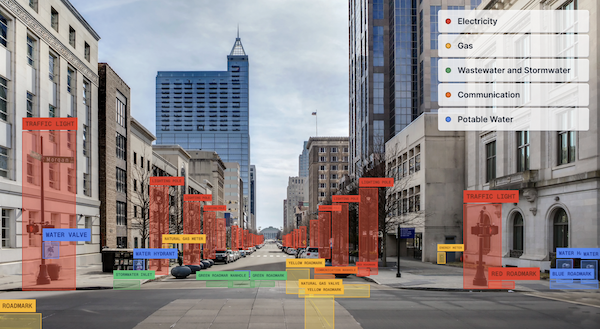
- AI-Generated Lines: Using existing records and on-surface utility evidence, we use AI to generate utility lines, without humans in the loop. When traditional records thin out, 4M intelligently infers likely utility lines by connecting detected objects and road marks to identify the network, pattern-matching across records and imagery, and filling gaps with new, data-driven linework you can validate.
- Utility Evidence Layers: Object Detection & Road Marks: 4M continues to strengthen the evidence behind every utility decision, giving you greater confidence in your project before anyone sets foot on site. We enhanced our Object Detection capabilities, identified new objects, and road marks.
- Utility Insights Dashboard: Utility Insights leverages 4M’s utility analytics and 4M AI Agent to provide actionable insights by analyzing the relationships between existing utility line locations, metadata, Right of Way (ROW), parcel zoning, and utility intersections. This data aids in project risk assessment and helps accelerate project timelines by identifying critical permit and easement requirements early on.
- WFS API and CAD Download: Now, 4M customers have the ability to bring 4M data into their design tools for easier data sharing and collaboration. With the WFS API, you can stream 4M data into GIS and CAD tools so you always have up-to-date information. Additionally, we’ve recently added the ability to download Foundation data projects as CAD files. Reach out to your 4M representative to learn more and get access.
3. Build Better Together: Partnering to Build Smarter, Faster, Safer
In a year where infrastructure projects continued to increase in risk and complexity, one theme stood out across the entire ecosystem: everyone benefits when stakeholders work from the same trusted data. The future of infrastructure isn’t siloed. It’s Better Together. Putting that belief into action, we brought the industry together across partnerships, webinars, events, white papers, and podcasts—creating space for more open dialogue around collaboration, risk reduction, and digital transformation.
This year, we saw the industry take meaningful steps toward a more connected future: one where teams don’t just share goals, but share the same trusted foundation to achieve them.
Through partnerships, we put our utility data into the platforms and processes where teams already spend their time. This year, we made real progress on a simple goal: get 4M’s utility intelligence into the tools engineers, contractors, DOTs, municipalities, and utilities use every day. Our integrations and APIs push utility data directly into GIS, CAD, and field workflows, enabling teams to validate faster, coordinate earlier, and keep systems aligned as conditions change.
Technology partnerships keep GIS, CAD, and field teams in sync:
- Bentley Ecosystem Program: Through the Bentley Ecosystem Program, we increased access for Bentley users by establishing 4M’s presence in Bentley environments, making it easier for teams to adopt 4M outputs directly into design and modeling workflows.
- Esri Partner Network – ArcGIS Workflows: As part of the Esri partner network, we expanded how teams stream 4M utility data into external GIS environments via our WFS API, giving customers more control so they can share the right utility layers with the right stakeholders—and keep project data current.
- Trimble Partner Network: Within the Trimble Partner Network, we developed a V1 integration connector to bring 4M utility data into Trimble Connect, so field teams can validate utilities with TerraFlex and visualize subsurface utilities in AR with SiteVision—bridging office-to-field coordination around one shared dataset. (coming soon in Q1 2026)
Reseller partnerships bringing 4M directly to the market:
- WSB Reseller Partnership: We also took a significant step in distribution: WSB is now delivering the 4M platform directly to the market, expanding access to trusted utility data and AI-driven insights for infrastructure stakeholders in real-time. This partnership pairs 4M’s utility intelligence with WSB’s delivery strength—so owners, engineers, and builders can reduce utility uncertainty earlier and keep projects moving. Read the entire press release.
We hosted events in-person and online:
- We hosted the Colorado utility workshop, which tackled one of infrastructure’s most persistent pain points—utility coordination—and Colorado’s innovative new solution to this pain point, House Bill 24-1266. Check out what Build Better Together means to industry stakeholders!
- We co-hosted the “Enhancing Damage Prevention & Public Safety with AI Innovation” webinar with Energy Central, featuring National Grid and Dominion Energy on how the industry is innovating utility coordination and risk mitigation.
- Roadmap to Build Better Together: Led by Sr. Product Director Kaustubh Page, this webinar gave the industry a front-row seat to our vision, detailing specific product innovations to help infrastructure teams build smarter, faster, and safer—together.
CEO and co-founder Itzik Malka appeared on quite a few podcasts!
- Bricks & Bytes: “Building the Google Maps of Underground America — This Ex-Soldier Mapping What’s Beneath Our Feet”
- Energy Central: “How AI is mapping the invisible grid underground”
- Giatec’s Construction Revolution: “Unveiling the Subsurface Network with 4M Analytics”
- Builder Tactics: Beneath the Surface: Itzik Malka on Future-Proofing America’s Infrastructure
- Avicado’s Wired to Build: “The Google Maps of Infrastructure with Itzik Malka” (Part 1 + Part 2)
We published several white papers diving into applied use cases for industry challenges:
- The New Era of Utility Mapping: Redefining Damage Prevention Through Artificial Intelligence: How can the emergence of AI—collecting, interpreting, and synthesizing vast amounts of siloed utility data—transform the utility asset management lifecycle and support the 50-in-5 challenge for damage prevention.
- Texas Utility Environmental Risk Report: This report identifies high-risk pipe materials through sampling in Texas, evaluates where they are located and why they pose a great concern, and outlines clear recommendations for environmental risk mitigation.
- Transforming Infrastructure with Advanced Utility Data: Why the industry needs a unified repository of comprehensive utility data in order to evolve the way we design and build around existing utilities so that unplanned disruptions and unsustainable risk levels become a thing of the past.
- Maximizing Underground Design Efficiency Now and in the Future by Mike Beehler: What if we could drive better alignment, transparency, and outcomes to bring project stakeholders together from the start? When everyone involved can instantly access the same reliable data, projects move forward quickly, decisions become clearer, and outcomes improve.
4. Company expansion: Growing to Support a Bigger Vision
To meet rising demand and support a rapidly expanding ecosystem, 4M grew meaningfully in 2025. We strengthened our leadership team, scaled our go-to-market and engineering organizations, and expanded our workforce to better serve customers and partners across the country.
Our team grew by 12%, and we moved into a new office in Israel to support continued collaboration and growth. We added key leadership members, including Aran Pauker (VP R&D) and Omry Hochberg (VP Operations), and expanded our go-to-market organization by 25%.
We also deepened our strategic guidance with the addition of two new advisory board members—Jemmie Wang (acretivPartners) and Leslie S. Richards (former CEO of SEPTA and Secretary of the Pennsylvania Department of Transportation)—bringing decades of experience across infrastructure, transportation, and industry leadership.
But growth in 2025 went beyond headcount. We reinforced our core values as a shared compass for how we work, while fostering an operational excellence mindset focused on accountability, consistency, and execution at scale. Communication and transparency have become central pillars of how we operate as we look ahead to a period of significant growth, with expectations to nearly double the team in 2026. By continuing to invest in leadership, clear and open communication, and talent development, 4M is positioning itself to scale from a place of strength and sustain long-term success well into the future.
5. Looking Ahead to 2026: Extending the Impact
As we move into 2026, we aren’t just maintaining momentum. We are expanding the mission.
The future of infrastructure relies on connection, which is why we are taking the Build Better Together movement on the road.
Starting with the Georgia Department of Transportation (GDOT) and expanding to DOTs across the country, our upcoming roadshow series will convene the entire ecosystem. We’re bringing together project owners, engineers, utilities, and technology partners to break down silos in real time and explore how shared, reliable utility data accelerates planning, reduces conflicts, and enhances safety across state lines.
The path ahead is clear. When stakeholders begin with the same reliable information, they deliver better projects. We invite you to be part of that transformation. Join us on that journey and let’s build the future together.

Recent blog posts

.png)

.svg)
.png)

Our Newsletter
Join 7k infrastructure professionals
Get monthly insights on ways to build smarter, faster and safer with Utility AI.