Mapping the Hidden City 1: Building a Digital Underground Baseline
Written by

Tamar Shafrir
Published on
.svg)
June 9, 2026
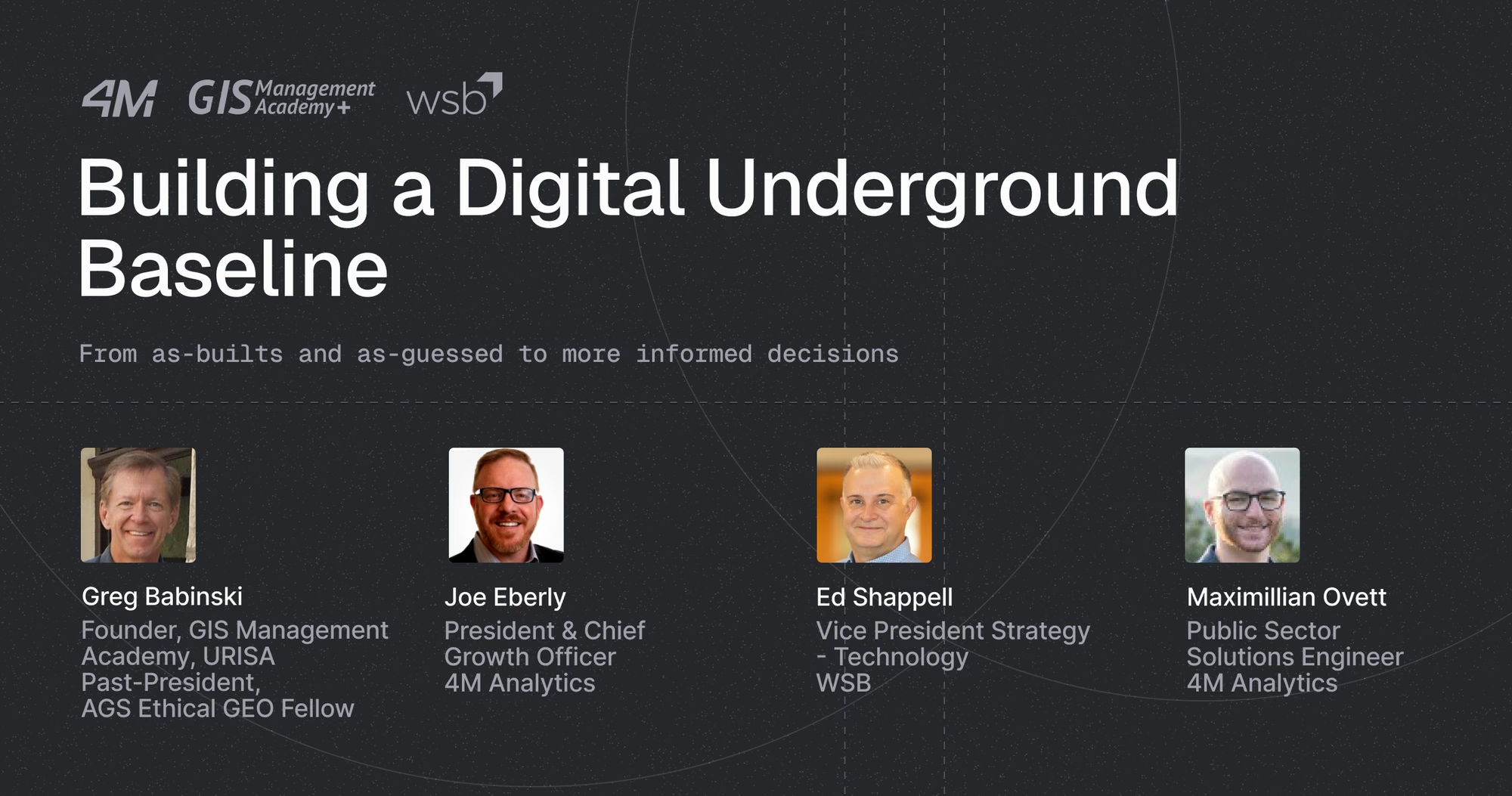
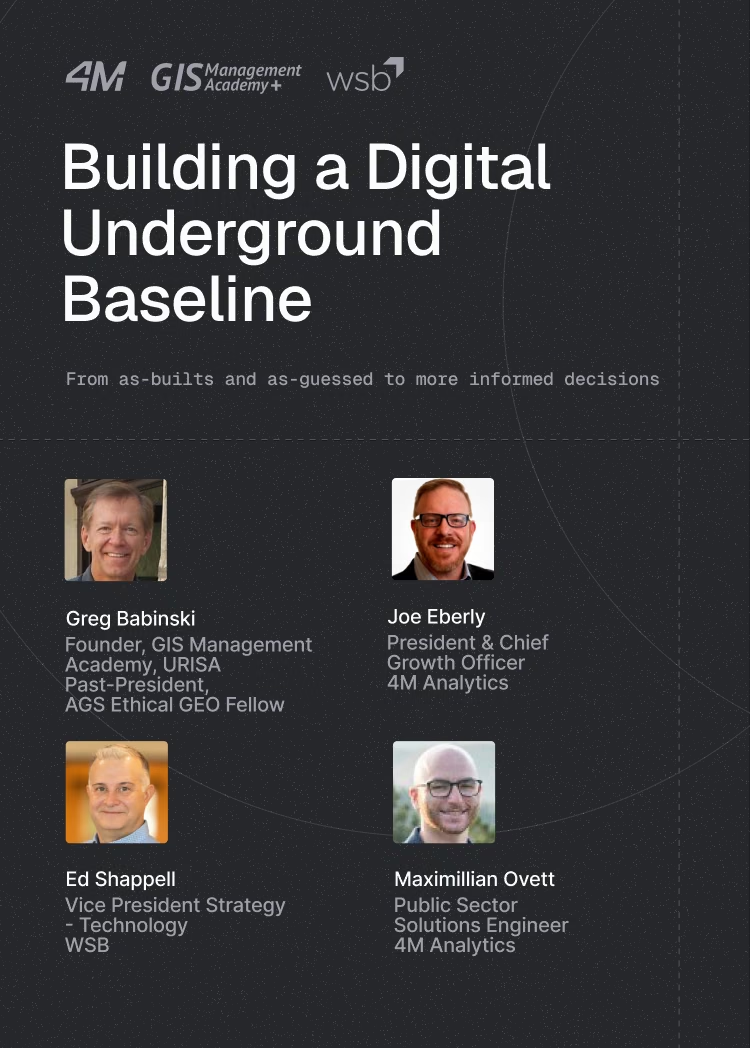
Table of contents
Right now, damage prevention tends to begin just a few days before ground is broken on a project with an 811 dig ticket. But the system is struggling to keep up with demand and reduce damage rates over time. Every 2 minutes, someone hits a buried utility line in the US. That’s 230,000 utility strikes per year, according to the Common Ground Alliance. Furthermore, half of utility locating requests weren’t filled in time, meaning either excavation delays or breaking ground without precautions.
New AI-powered utility mapping platforms like 4M help agencies better use the data they have, and know what they don’t have, to build a reliable underground baseline. That helps everyone gain a clearer understanding of underground conditions before an excavator rolls onto the site and unearths an unwelcome surprise.
On the first Mapping the Hidden City, Joe Eberly, President and Chief Growth Officer at 4M, and Ed Shappell, Vice President of Strategy and Technology at WSB, joined moderator Greg Babinski to walk through what it actually takes to build a digital underground baseline and why starting earlier in the project lifecycle changes everything. Here are the can’t miss takeaways.
Why is underground data confidence so hard to get right?
Keeping utility records updated is genuinely difficult for many reasons.
Municipalities, state agencies, and asset owners are dealing with networks that have been built, modified, and extended over decades, often by multiple utility owners with different standards, different formats, and different levels of documentation. Field data from construction projects sometimes takes years to make its way back into official records, if it ever does. And when it does arrive, it might conflict with what's already on file, without an obvious path to rectification.
Agencies inherit inconsistent maps that undermine confidence during planning and construction. Shappell put it plainly: agencies may have good GIS data on their utility networks today, but they’re often missing critical metadata like vertical depths, pipe diameters, material types, and even ownership. The map might look complete on the surface, but out in the field it’s not detailed or consistent enough to be a useful and reliable guide.
Add in an aging workforce that’s retiring without enough replacements in the talent pipeline and a nationwide push for fiber internet introducing even more new underground utility lines — and an already strained recordkeeping system is hitting its breaking point.
“Understanding and knowing what's underground is the number one challenge in delivering infrastructure projects," Eberly said. "The metrics show it: in damages, in claims, in challenges, in design and changes that have to occur. Utilities are at the core of just about all of it.”
How does getting baseline utility data earlier reduce project risk?
Catching a conflict between a proposed design and an existing underground feature in early design can cost thousands of dollars to resolve. Missing that same conflict until construction starts? You’re looking at millions of dollars instead.
Babinski brought up a compelling example of this kind of delay. As a major tunnel under the Seattle waterfront was being built about a decade ago, a tunnel boring machine hit a previously unidentified piling. The machine was out of commission for nine months of repairs, and the project was on hold while that happened. The schedule impacts and the delay costs kept mounting, all because of one underground unknown.
WSB’s approach starts with pulling 4M’s utility data map into their design environment early — ideally before 30% design — and building it out into 3D. On a recent project in Houston, a WSB team was able to model all of the utilities in weeks instead of months, giving the design team significantly more time to evaluate conflicts and explore alternatives.
One of those early catches was a potential clash between proposed foundations for a bridge and a 144-inch sewerage pipe. Identifying that line in the design phase meant the team could engineer an alternative solution right from the beginning and avoid a massively damaging strike on a key piece of community infrastructure.
"It's hard for municipalities and DOTs to keep all of their asset data up to date," Shappell noted. "Having a baseline map is a great way for them to look at where they might have changes or updates to be made and where their gaps are."
What we can build together when everyone is on the same page
When a project team has a single baseline map that combines 4M’s utility data with 811 locate data, field survey information, and the proposed design, collaboration between stakeholders shifts for the better. RFIs get resolved faster because everyone is looking at the same information. Cross sections that show utilities against the design make conflicts clear and understandable even to project stakeholders that aren’t engineers.
That second point is key — you shouldn’t need deep technical expertise to read and interpret utility data on a project, because not all stakeholders are engineers. When the data is modeled in 3D and presented visually with cross sections, conflict overlays, and phased construction views, then everyone can understand at a glance what they’re looking at.
"Everybody is working from a single data set that was very good to use visually," Shappell said. "You don't need to be an expert to be able to view and look at conflicts."
What does the future of utility mapping look like?
Eberly laid out an exciting five-year vision for a cloud-based, constantly updated utility model: a living, breathing data set that anyone involved in a project can access and pull into their own systems or into the 4M platform at any point in the project lifecycle.
That model would include not just line locations, but the full metadata picture: who owns the line, what it’s made of, when it was installed, and how deep it sits. And through AI-driven processes like object detection and records conflation, the goal is to fill gaps in utility data even where complete records don’t exist.
And complementary technology exists that could help reduce the risk of strikes, if the utility data were more comprehensive and reliable. There are excavators in the market today that can stop a blade before it hits a buried utility — but the limiting factor isn’t the machine, it’s the maps. The safety technology is ready, the data isn’t (quite yet). And that lack of data is affecting not just physical construction, but also the capability to incorporate AI and agentic workflows into project development.
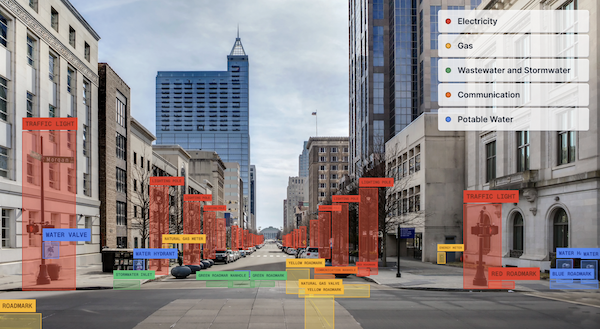
4M’s platform is already part of this future — it pulls together tens of millions of public records for entire states, applying AI to geolocate, validate, and fill coverage gaps. Above-ground object detection, like identifying manholes, valves, fire hydrants, and even locating roadmarks from imagery, adds another layer of validation.
"We can map the gas network in a city without having access to any of the utility owner’s records," Eberly said, "because we can see the entire constellation of evidence and train the algorithms to begin to draw the networks themselves."
Both Eberly and Shappell emphasized that accuracy is a journey, not a checkbox, when it comes to utility data. The baseline layer starts within a few feet of accuracy. Over time, as field locates, survey data, and as-built information are fed back into the platform, the data gets more precise. It’s not designed to replace 811 or field verification, but to make every step in that process faster, better informed, and less likely to produce surprises (and strikes).
FAQs
What is a digital underground baseline?

A digital underground baseline is a foundational data set that maps the location, type, and attributes of buried utility infrastructure across a project area or jurisdiction. It combines records from multiple sources — public records, GIS data, field observations, and AI-generated mapping — into a single reference layer that teams can build on as a project moves through planning, design, and construction.
How accurate is AI-generated utility mapping data?
AI-generated utility maps provide a planning-grade baseline, typically within a few feet of actual utility locations. Accuracy improves over time as field locates, survey data, and as-built information are incorporated. The data is designed to complement — not replace — 811 locates and field verification, giving teams a headstart rather than a final answer.
Can 4M's utility data integrate with existing GIS and design platforms?
Yes. 4M's data can be downloaded in GIS and CAD formats, pushed through WFS connections, or pulled in through APIs. Teams working in ESRI, Autodesk, Bentley, Trimble, or other environments can bring the data into their existing workflows without switching platforms.
How does 4M support new users who are just getting started?
4M provides a structured onboarding program through their Client Success team, an in-platform help center with live support, and 4M University — a self-paced learning resource covering project creation, object detection, data sharing, and more. Whether you're a small municipality with no existing records or a large DOT integrating with established GIS systems, the platform is designed to meet you where you are.
Tamar Shafrir
A dedicated researcher that doesn’t stop investigating until she reaches the truth, no matter how hard it is to accept or comprehend (and there are a lot of those in our industry). Tamar took her first career steps in architecture and design, both as a practitioner and a journalist. Throughout her journey, her curiosity has taken her all across the globe, from North America through Europe to the Middle East, discovering and explaining the micro and macro challenges of the industry. Today she focuses most of her efforts on unlocking the challenges of the subsurface, through research and education.
Recent blog posts

.png)

.svg)

.png)

Our Newsletter
Join 7k infrastructure professionals
Get monthly insights on ways to build smarter, faster and safer with Utility AI.