The new industry standard for utility data
Written by

Chris Garafola
Published on
.svg)
March 5, 2026
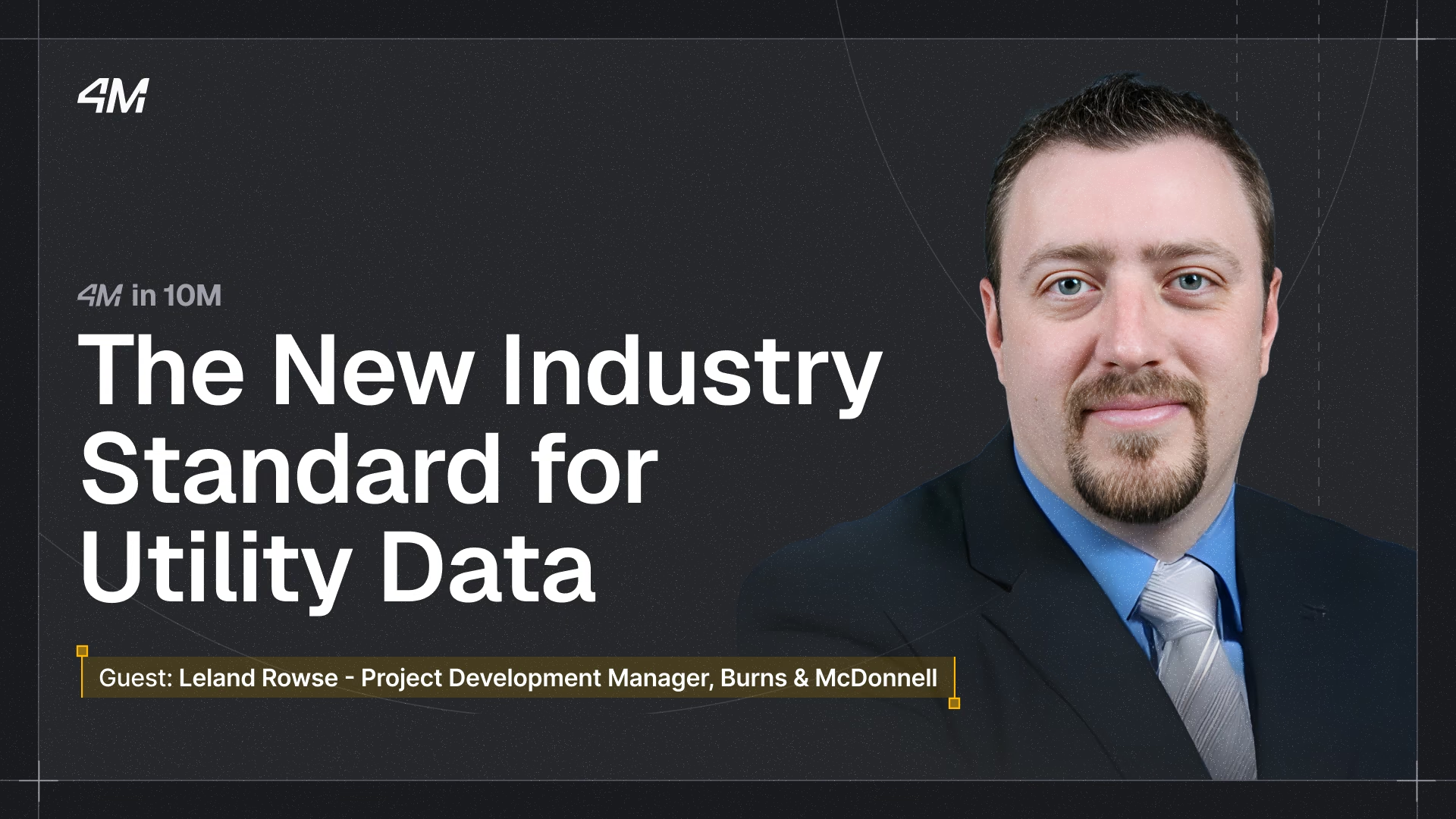
Table of contents
AI-powered utility data is only as valuable as the teams that actually use it. So how does a 100-year-old engineering firm with 14,000 employees get its people to embrace AI-driven mapping tools—and make them stick?
In this episode of 4M in 10M, host Chris Garafola sits down with Leland Rowse, Project Development Manager at Burns & McDonnell, to unpack how one of the nation’s largest engineering firms is adopting AI-powered utility data at scale—and why the companies that move first will be the ones that pull ahead of the rest.
Why did Burns & McDonnell start using utility AI mapping?
Rowse has been with Burns & McDonnell for 30 years—when he started, they were still hand-drafting and saving their files on floppy disks. He’s been in the transmission and distribution world, in the underground submarine cables group, since 2004. The pace of change he’s seen, particularly in the last few years, is astonishing.
And despite his many years of experience in the industry, Rowse is far from complacent. He enjoys pushing the envelope of what’s possible with new technology, and 4M fit a need his team had already identified.
"This was an innovative tool that we had been talking about even before we came upon 4M for a couple of years," he says. When the team saw what the platform could do, it accelerated their timeline. "It just helps Burns & McDonnell stand out as a partner with 4M and in the industry at this point."
What does adopting new technology look like at a large engineering firm?
Onboarding a new technology isn’t actually the hardest part of embracing something new, even at an established firm like Burns & McDonnell. "People are always toughest to adapt to change," Rowse says. "Computers you can change—they don't complain."
To address this change management challenge, Burns & McDonnell took a methodical approach instead of rolling 4M’s utility data platform out company-wide all at once. They started with smaller teams, demonstrated results, and then expanded step by step—a lesson they’ve learned from past software rollouts that didn’t go quite as well. "What we've seen in the past is when we come in with a new software and we say everybody's got to use it — not everybody's going to use it, and it's hard to manage."
One key to a successful rollout is finding the people who want to push the envelope to serve as change ambassadors. Once they see positive outcomes, others will take note and follow. And once the technology becomes part of someone’s workflow, they can’t imagine going back to a world without it.
Where is 4M making the biggest impact on project delivery?
Right now, Burns & McDonnell is seeing the most immediate value in proposals and feasibility work—the early stages where having reliable utility data can shape how a project gets scoped, priced, and planned.
But Rowse sees the platform's role expanding. "We're looking at different ways that we can use different groups within our company," he says. "Can we actually incorporate it into design at some point?" As 4M’s capabilities grow, so do the potential use cases as teams across the project lifecycle work from the same reliable data source.
That kind of alignment is central to how 4M thinks about the industry’s biggest challenges. When every stakeholder—from proposal writers to designers to field crews—can access the same reliable data and integrate it into the workflows and technologies they already use, projects move forward faster and with fewer surprises. It’s the difference between teams working in siloes and teams building better together from a shared baseline and a central source of truth.
Rowse is also realistic about ROI expectations. "You might not see it right up front, but you will be seeing it at the end or even partway down. So you can't always just go by, I'm not seeing it immediately. You have to give it time."
What's next for AI-powered utility data?
Rowse is clear about where he sees the industry heading: "I really see 4M just becoming a standard, and if you're not using it then you're falling behind in the industry."
With his decades of experience in the industry, he’s seen this pattern over and over again—one company adopts a new tool, gains a competitive edge, and everyone else falls two years behind. "If you're not in front of it, you're behind it. And that's not where we want to be as a company."
Rowse says that people are more difficult to align on infrastructure projects than data or technology. But he also sees trusted data as the key to unlocking all three factors: "If the data is reliable, it makes the people understand that and they're willing to change that much faster and implement it into their daily process."
That insight captures something important about the future of utility data. The technology already exists. The data is becoming more accessible, reliable, and actionable. The remaining challenge is getting people aligned around it—and the firms that do that will be the ones building better together with their colleagues, clients, and communities.
The 10-second takeaway
The biggest barrier to innovation isn't the technology alone—it's getting people to adopt it. Reliable data accelerates that adoption and aligns teams and stakeholders.
Watch the full episode to get the full deep dive on how Rowse is using 4M, which industry buzzword he’d most like to ban, and his favorite infrastructure project designing all the utilities for a tunnel 190 feet under a river in New York.

Recent blog posts

.png)

.svg)

.png)

Our Newsletter
Join 7k infrastructure professionals
Get monthly insights on ways to build smarter, faster and safer with Utility AI.