How AEC Firms Are Spending Less Time on Utility Research and More Time Solving Design Problems
Written by

Published on
.svg)
April 29, 2026


Table of contents
Traditional utility record research has been a time-consuming process for infrastructure professionals for decades, but new and innovative technologies are shifting that status quo. In this episode of 4M in 10M, host Chris Garafola sits down with Craig Friant, Utah Civil Practice Lead at Wilson & Company, to talk about how 4M's utility data platform has changed the way his team approaches roadway and corridor design — cutting the time spent tracking down utility information and giving engineers more time to solve the problems that actually require their expertise.
How is Wilson & Company getting utility data faster?
Friant’s group does extensive roadway and corridor design. “We look at them, and we think this is just a corridor for roads, for people to drive their cars, but it's not. Roadway corridors are utility corridors and transportation corridors.”
In the traditional utility mapping process, he would have to reach out to each utility individually to request the information he needs to do his job. Some of those utilities respond quickly, but others take weeks to deliver data. And then, once the data was in, he’d spend more time compiling each individual map into a single file.
But 4M’s utility data platform has significantly shifted how he conducts utility research. Friant was the first person at Wilson & Company to use 4M on a project last fall. He was working on a feasibility study for the design of a pedestrian bridge over an intersection and needed to know where the utilities were during the preliminary design phase.
“We were able to use 4M and it was great. It did it quickly, it was cost-effective. We didn't have to spend time tracking down maps and things. And we could share maps with our clients and say, hey, these are the utilities we have out here. They could look at it, see it, and get feedback.”
Friant’s team not only used 4M to obtain the data they needed but also sent some of the information back to 4M and made tweaks to improve future accuracy. It’s a dialogue that’s constantly improving.
“I can just look at a map really quick here in my office, know what's out there, develop a game plan, and then move forward,” Friant says. “Instead of having to guess what's out there, go down the road, find out it was wrong, come back, reconfigure things, and then go forward again. It gives us that information early so that we can make correct decisions early on and avoid a lot of pitfalls.”
The format the data is delivered in saves him time as well — he notes that he can download GIS files from 4M and import them directly into his CAD drawings, seamlessly incorporating them into his design.
What's the biggest impact of 4M on engineering design projects?
The most meaningful change that Friant sees in his own work is not just the speed with which he gets utility data, but what he can do with all the time and effort saved. Instead of spending time figuring out where the site's utilities are, he can now focus on how each project will impact those utilities.
“I can get to solving the problem much quicker because I don't have to spend so much time trying to map things. I can get it quickly, and then I can start looking at it and say, "Okay, here's the conflict. We need to make this adjustment in our design to avoid this power pole, or we need to adjust the height of the road so we're maintaining cover over this fiber line.”
He’s able to take on more high-value problem-solving to better serve his clients. The platform isn’t doing the work of an engineer; instead, it provides engineers with the time they need to address the complexities of building in dense environments.
“We can avoid so many problems if we know where utilities are and know what's out there on our projects early,” Friant says. “We don't have to spend a lot of time going down the road, trying to map things ourselves. It gives us information quickly and early. We can make decisions during our pursuit, as we're talking to clients and writing proposals trying to win work.”
That speed also translates directly to cost savings for Friant and his clients, letting them move through projects with fewer surprises and less rework.
How reliable is AI-generated utility data?
Friant says that peers considering AI for utility mapping need to remember what they’re getting: information to tell them what’s out there as a foundation. It’s not always a fully finished view, but information that they can further refine as they verify the maps in the field and look at the street view to make adjustments.
“It helps us get our maps and know where we start. It's a way to really quickly see what's out there,” he explains. “AI helps us to see where a lot of that infrastructure is. And then we take it from there and we verify it.”
.png)
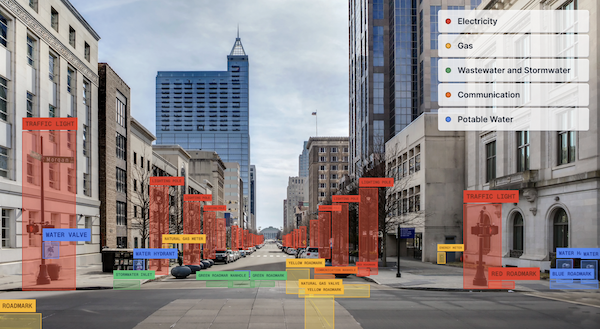
One of the features Friant values most for these tasks is the street view option. He pulls the 4M data into CAD, then typically tweaks it based on his deep experience and Wilson & Company's data. “It was kind of surprising to see how accurate it was, and it helps us to identify where things are.”
Friant has found that 4M’s multi-source utility intelligence is helpful, especially when records are incomplete or inaccurate. It doesn't always deliver a perfectly clear answer—but it provides enough information to confidently move forward.
For example, if he’s on the platform and the AI points out a power pole in an area where his firm did a topographic survey, he can take those sources and figure out what he needs to know to move forward on the project, like where a power line is based on the location of the power poles or manholes.
“We know that the important thing is to know that this is the line that we have. This is who the owner is. This is approximately where it's at,” he says. “And that's most of the information we need. As we move forward in the project, we can adjust things as we need to, refine it, and be able to use it for our design.”
Better project planning and delivery doesn’t require perfect data, but it’s made significantly faster and more cost-effective with reliable, instant data that aids the humans who make the whole process work.
The 10-second takeaway:
When civil engineering teams can access utility data in minutes instead of weeks, they stop spending their time gathering information and start spending it solving problems.
Watch the full episode for a deep dive into how Friant uses 4M for instant utility intelligence in his day-to-day work, why he admires ASCE enough to take on a leadership role in it, and his hidden passion for road biking.
FAQ
How does 4M compare to traditional utility records requests?

Traditional utility research requires contacting each utility company individually — some respond quickly, others take several weeks — then manually compiling every map into a single file before design work can begin. With 4M, that same information is available almost instantly in one place. Craig Friant, Utah Civil Practice Lead at Wilson & Company, describes the difference: "Instead of having to guess what's out there, go down the road, find out it was wrong, come back, reconfigure things — it gives us that information early so we can make correct decisions early on and avoid a lot of pitfalls."
Can 4M data be imported directly into CAD software?
Yes. 4M delivers utility data as GIS shapefiles that engineers can download and import directly into CAD drawings. Craig Friant, Utah Civil Practice Lead at Wilson & Company, used this on a Salt Lake City survey project where his team needed utility data incorporated into deliverable maps under a tight deadline. "We got that information pretty quickly, were able to download it, get it in, and finish up the maps and get them delivered to our clients," Friant says. "It really helped us do it quickly and efficiently."
How do engineers verify utility data from 4M in the field?
Engineers use 4M as a starting foundation, then verify against their own sources. Craig Friant, Utah Civil Practice Lead at Wilson & Company, pulls 4M data into CAD and cross-references it against topographic survey results — adjusting line positions where he has confirmed field measurements. 4M's built-in street view lets him visually confirm above-ground features like power poles and manholes before going to the site. "We know the important thing is to know that this is the line we have, this is who the owner is, this is approximately where it's at — and that's most of the information we need," Friant says.
Is 4M useful during the feasibility and preliminary design phase?
Yes. Craig Friant, Utah Civil Practice Lead at Wilson & Company, first used 4M during a pedestrian bridge feasibility study, when he needed utility locations before any design decisions were made. 4M gave his team a shareable utility map within minutes, allowing them to loop in the client early and gather feedback in real time — without waiting weeks for records from individual utility companies. "We can make decisions during our pursuit — as we're talking to clients and writing proposals trying to win work," Friant says. "It's really helpful when we're doing feasibility studies."
Recent blog posts

.png)

.svg)



.png)

Our Newsletter
Join 7k infrastructure professionals
Get monthly insights on ways to build smarter, faster and safer with Utility AI.