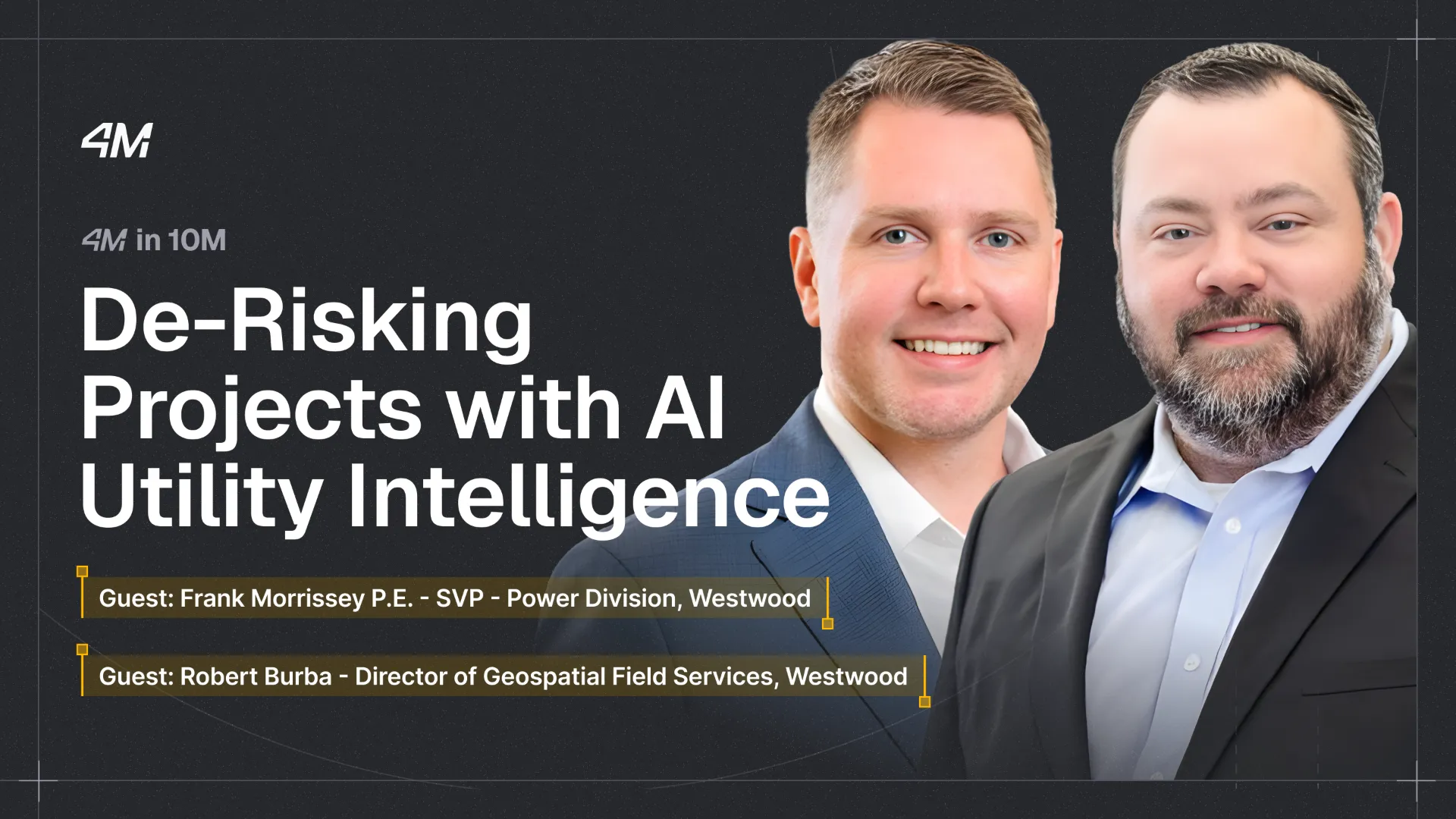
Tracking down utility information before a project starts has always been slow, manual, and full of gaps — and the consequences of missing something range from inaccurate proposals to utility strikes in the field. On this episode of 4M in 10M, host Chris Garafola talks to Frank Morrissey, Senior Vice President of Power Division and Robert Burba, Director of Geospatial Field Services at Westwood Professional Services about how 4M helps their teams manage risk from the proposal stage through field execution — including a project where they discovered 50% more utilities than expected before anyone left the office, and the 811 automation feature they're beta testing with 4M's team.
Why did Westwood add an AI utility data platform to its workflows?
Westwood started in the land development space more than 50 years ago, so when they learned about 4M’s utility data platform, they saw the immediate opportunity to quickly site their projects and find existing utility infrastructure.
“Having that at our fingertips quickly allowed us to narrow down and identify where land development needs made sense, and then also where that existing infrastructure that would drive the lowest costs for that development was located,” Morrissey says. “So from there, we had an advocate internally, but then with myself joining the team and looking for ways to drive more efficiency in the business, we looked to pivot that to more of the utility infrastructure, the T&D side of things.”
For Burba, the traditional utility mapping approach — chasing records, waiting on responses, piecing together incomplete datasets — left too many unknowns heading into the field. What excited him about 4M was the ability to surface that picture for clients at the very start of a project, before the scope was locked and the risk was already priced in.
50% more utilities than expected — before anyone left the office
Burba notes that recently on a large project in a semi-urban area that Westwood bid on before they were using 4M, but by the time they were preparing to go out to the field, they were. They got someone from the land team who was familiar with it to give the team a quick training (“And it really was quick training,” Burba says), so they pulled the data before they went to the field. And they realized all of a sudden that there were 50% more utilities on this project than they had planned, based on the information they had.
They were able to go back to the client, inform them of the utility discoveries, let them know they’d be in the field a bit longer than planned, and adjust the timelines for the property owners. The client maintained a good relationship with the landowners, and there were no additional costs to the client. The team completed double the planned field work in the same timeframe — because they knew what they were walking into. “This wasn't a large project, but that's what sold me on 4M: the first job worked really well that we implemented it on,” Burba says.
How will 4M help Westwood automate the 811 process?
Now Westwood is using 4M for their growing utility locating group as well, since they’ve added SUE services and handle tens of thousands of 811 tickets. Burba and his team have been working with 4M on a new feature to automate 811 calls, which is currently a multi-week process and will likely drop to just a few days once the feature is live.
“That's one of the big things I'm really looking forward to, because it's just a drag,” he says. “It's something we have to do on 99% of every project we touch. It's making a phone call. It's hoping somebody calls you back. When they don't call you back, you have to wait on the next person. And what 4M is working towards is just the best possible solution to this dilemma that we deal with on a daily basis.”
Since Burba’s team is already saving time by integrating 4M into their workflows, they’re able to spend more time on QAQC, a critical component of the added SUE services. His team members traditionally spend 15 hours per week just on 811 calls, and automating that process will free them up to focus more on that strategic work.
How does 4M support risk management for Westwood?
A large part of Morrissey’s job is managing risk: internal risk, proposal risk, and financial risk for Westwood. That’s why his first question when a purpose team is creating a proposal is, “Did you 4M the project?” The platform helps everyone better understand what Westwood is signing up for to locate and how much time they’ll be spending in the field. And for Morrissey, he now feels more comfortable about the proposals going out the door. “Accelerating risk management for our company is very exciting for me personally,” he says.
He sees the risk reduction happening at two levels — one is as an engineering and geospatial tool for submitting proposals and managing Westwood’s personal financial risk in those proposals. But it’s also helping their customers, clients, and partners avoid utility strikes, which he finds valuable for managing another kind of risk.
How should infrastructure teams think about integrating AI?
What most excites Morrissey about 4M’s platform is the potential for massive time savings enabled by its AI. The Westwood teams will always have to go to the field, no matter what — some imagery may be outdated — but 90+ percent of the project is probably already captured in the imagery they get from 4M. The platform can do that first pass, and then a human goes out and only has to do 10% of their job while just verifying that the other 90% matches what 4M’s already aggregated. “That's what I'm looking at with any AI tool, how do you add that to the process?” Morrissey notes. “Keep the human involved that is going to have the final say. But how do we remove some of the busy work from our people?”
He ultimately wants to use 4M to remove the manual data gathering and aggregating that takes up so much time for the teams at Westwood, allowing them to spend more time on critical thinking, verification, and engineering. Morrissey also doesn’t see integrating AI into workflows as a way to replace humans, but a path to more efficient designs that drive down costs for customers and rate-payers, so everyone can do more work that benefits everyone — truly building better together.
“I've been around AI for a couple of years now, integrating it into all of our processes,” he notes. “I've been a big advocate for it. And I can tell you, it all depends on the intelligent human driving the AI machine to deliver the product. I've seen certain teams use AI and just let AI do its thing without an intelligent human involved in it. And it's garbage in, garbage out. If we have our smart people that understand the industry — experts driving the AI machine — then we're going to have a much more efficient process and a more quality product.”
What's next for Westwood and 4M?
Morrissey is looking forward to some of 4M’s upcoming releases. As Westwood has expanded into overhead distribution and transmission work — with over 100 engineers in that practice — the demand for above-ground utility intelligence has grown with it. New capabilities like Pole Attachments and Attributes are part of 4M's expanding Visual Utility Evidence layer — combining AI-detected objects, road marks, and pole data into a single map so T&D teams can do corridor-scale inventory, attachment analysis, and relocation planning before anyone goes to the field.
“We're excited about some of the upcoming releases that we've been working with your team on that help us better do our overhead distribution projects using your platform,” he says. “How can we better aggregate that data to drive efficiencies in our overhead distribution and transmission projects as well?”
Watch the full episode to get the deep dive on how Westwood is using 4M today, how they’re anticipating using it in the future, and Morrissey’s beer-brewing hobby that’s coming to the Westwood office soon for a taste test.
How AEC Firms Are Spending Less Time on Utility Research and More Time Solving Design Problems
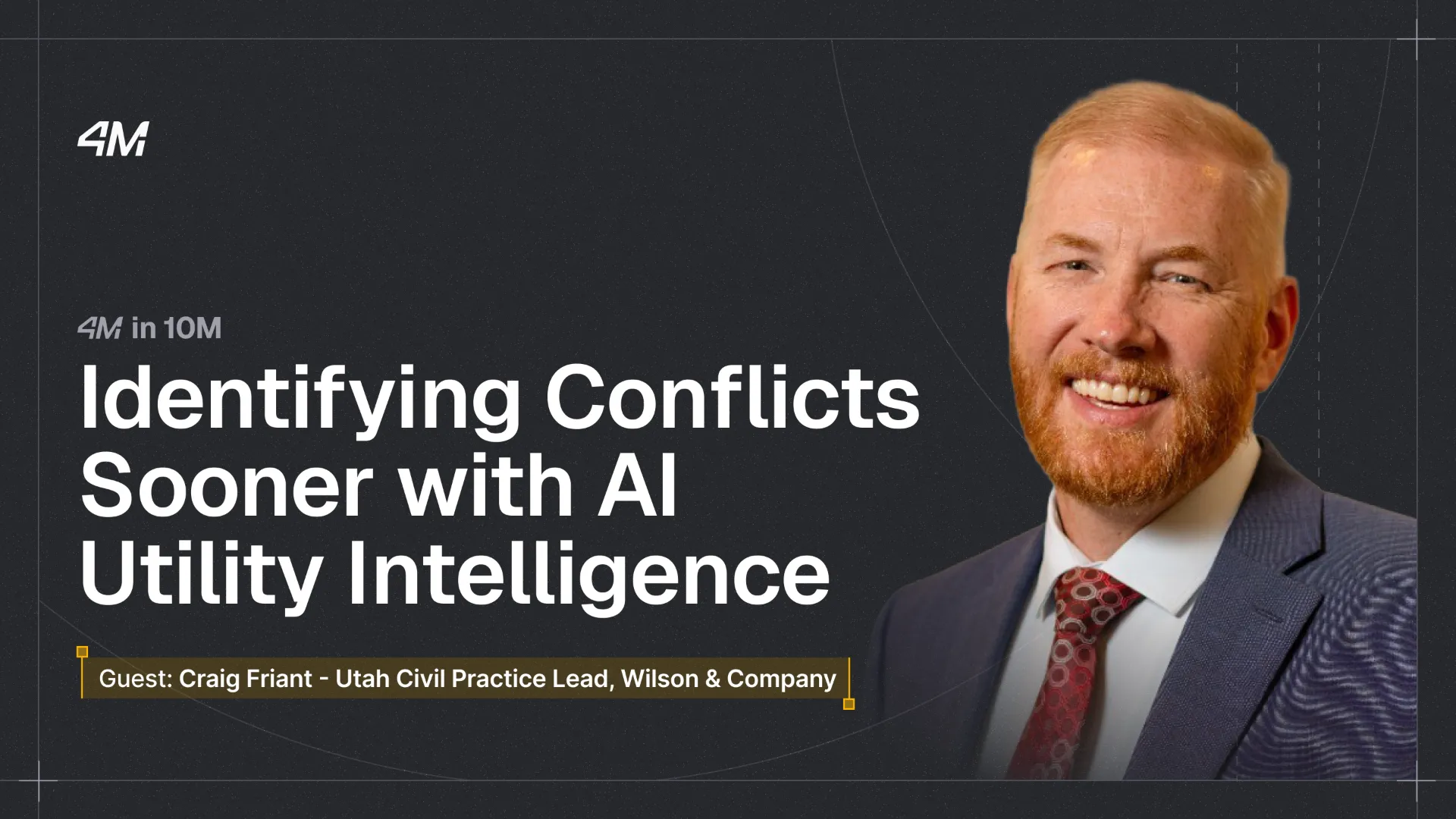
In this episode of 4M in 10M, host Chris Garafola sits down with Craig Friant, Utah Civil Practice Lead at Wilson & Company, to talk about how 4M's utility data platform has changed the way his team approaches roadway and corridor design — cutting the time spent tracking down utility information and giving engineers more time to solve the problems that actually require their expertise.



.svg)